What Golf Course Operators Need to Know Before Investing in Autonomous Maintenance Equipment
There is a demo happening at a conference right now that is about to cost your club two hundred thousand dollars.
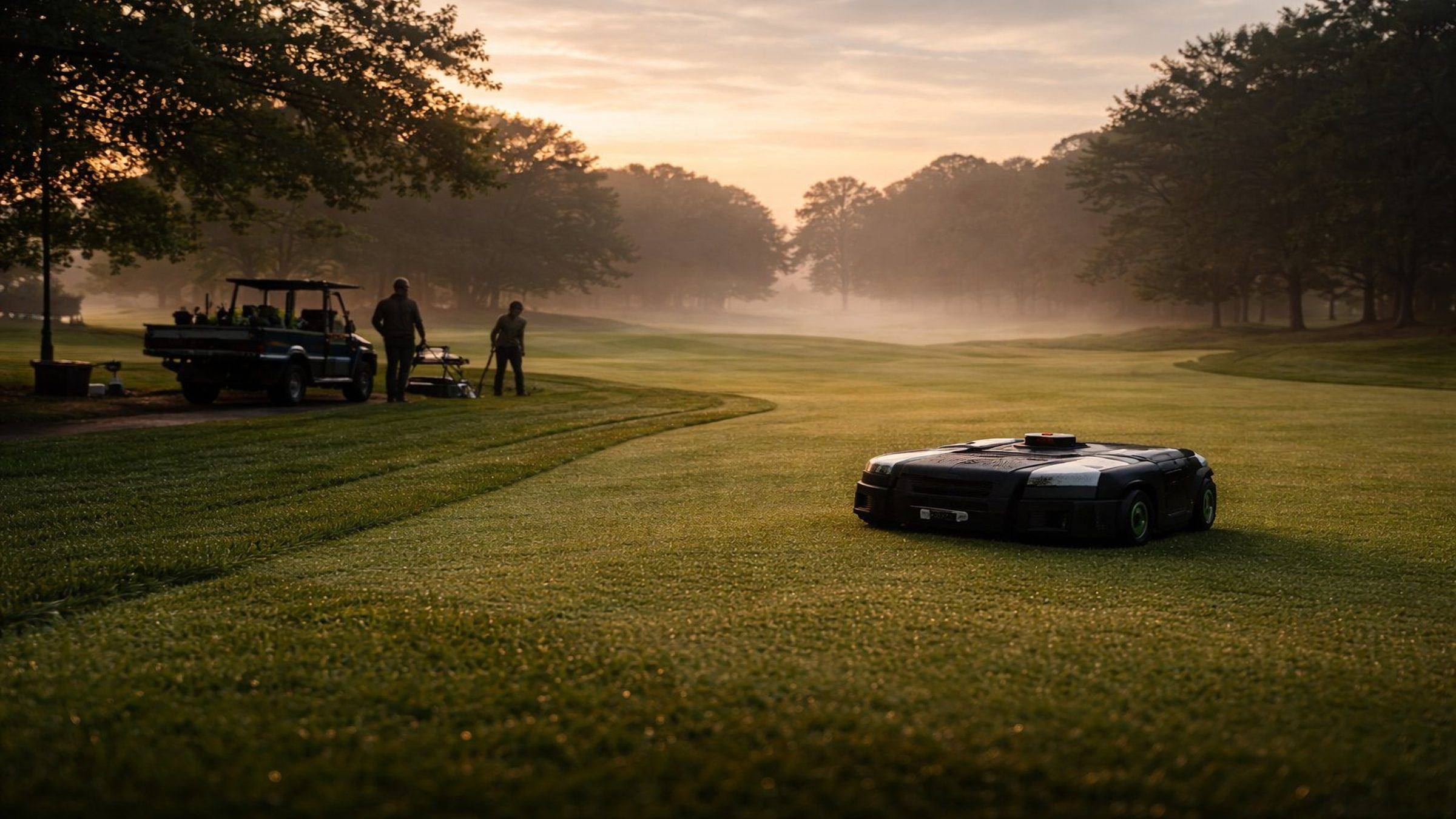
A board member is watching an autonomous mower glide across a fairway in perfectly straight lines. No operator. No diesel exhaust. No labor cost. The machine stops, turns, resumes. The sales representative is explaining ROI. The board member is already composing the email to the GM.
"We need to look into this."
And that is where the trouble starts. Not because the technology is bad, but because the decision is about to be made without the one thing that should come first: an honest understanding of what your maintenance operation actually costs today.
The Technology Is Real. Stop Pretending It Isn't.
Let us get this out of the way. Autonomous mowing is no longer a concept. It is commercially available, field-tested, and improving rapidly.
FireFly Automatix deployed reel mowers on a PGA Tour event where fairways were maintained exclusively by autonomous machines. Husqvarna's CEORA platform is operating at properties like Desert Mountain Club and Philadelphia Cricket Club. Toro acquired a European robotics company and launched its GeoLink autonomous fairway mower with GNSS precision guidance. John Deere has been building autonomous capability across its agricultural and turf divisions for years.
These are not startups. Toro and Deere are not exiting this market. They are investing billions in it. The clubs pretending this is a fad are the same clubs that dismissed online tee sheet booking in 2008.
The question is not whether autonomous maintenance equipment will be part of your operation. It is whether you will evaluate it like a capital investment or like an impulse purchase at a trade show.
The Cub Cadet Cautionary Tale
In 2020, Cub Cadet killed its RG3 autonomous greens mower program. Superintendents who had built their entire maintenance plans around the technology were stranded overnight. One superintendent described it as feeling like a death in the family. Another had to dig out fifteen-year-old walk-behind mowers from storage.
The lesson was not that autonomous mowing failed. The lesson was that betting your operation on a single vendor's unproven platform without a contingency plan is a capital risk that most boards never evaluated as such.
Toro and Deere are not Cub Cadet. They have the balance sheets and the market position to sustain long development cycles. But the principle holds: any capital investment that creates vendor dependency deserves the same scrutiny you would give a clubhouse renovation or a golf course redesign.
What Actually Works Today and What Doesn't
Fairway mowing is where autonomous technology has made the most commercial progress. GPS-guided reel and rotary mowers can handle open, relatively flat terrain with repeatable precision. The cut quality is real. The labor redistribution is real. Courses using these systems are freeing up crew hours for bunker work, detail mowing, and course improvements that were perpetually deferred.
Greens mowing is a different story. Since Cub Cadet exited, no commercially available autonomous greens mower exists. Greens require a level of precision, surface sensitivity, and environmental responsiveness that the current technology has not replicated at scale. This is the area where your superintendent's thirty years of pattern recognition still has no algorithmic substitute.
Complex areas like greens surrounds, bunker edges, tree lines, and slopes above fifteen percent still require human operators. The autonomous mower handles the middle of the fairway beautifully. It does not handle the places where your course's character lives.
And every autonomous system still requires infrastructure: charging stations positioned across the property, reliable cellular or Wi-Fi coverage on every hole, RTK base stations for GPS precision, and a technician who understands the software platform. That infrastructure has a cost that rarely appears in the sales demo.
The Math Problem Nobody Is Doing
Here is where most clubs get it wrong. A board member sees the demo, hears "reduced labor cost," and starts calculating headcount reductions. That is the math every vendor is selling. And for some operations it is the right math. For others it is exactly wrong.
The financial case for autonomous maintenance is fundamentally different depending on what kind of property you operate.
For Private Clubs: This Is a Revenue Investment, Not a Cost Play
At a $5M to $10M private club, total agronomic labor typically runs between twelve and eighteen percent of total operating revenue. An autonomous fairway mowing system from a major manufacturer will cost one hundred fifty to two hundred fifty thousand dollars installed, with another fifteen to thirty thousand annually in maintenance, licensing, and support.
The vendor pitch says you eliminate two equipment operators at forty to fifty thousand each. Eighty to one hundred thousand in labor savings against a two hundred thousand dollar investment. Four-year payback.
But if you actually eliminate those positions, you just removed the eyes and ears of your maintenance operation. Those operators were the ones who spotted the irrigation leak on five, noticed the drainage issue developing on twelve before it became a twenty thousand dollar repair, and reported turf stress before your superintendent could walk every hole. You traded institutional knowledge for a machine that follows a GPS line and reports nothing about course conditions.
The smarter private clubs are not cutting headcount. They are keeping the crew and redeploying them to work that was perpetually deferred: bunker renovations, green surrounds detail, landscaping improvements, irrigation system maintenance. Work that directly elevates the product your members experience every round.
And that is where the real ROI lives.
"An extra fifty dollars per month in dues across three hundred golf members generates one hundred eighty thousand dollars in new annual revenue. Members do not pay more for the same experience. They pay more when the product is measurably better."
The autonomous mower does not save your private club money. It gives your team the capacity to deliver a product worth more money. That distinction is the difference between a capital expense and a revenue investment, and most boards are evaluating it as the wrong one.
For Daily Fee and Public Courses: The Savings Are Real, But So Is the Risk
The financial picture at a daily fee course is fundamentally different. A public operation running thirty-five thousand rounds at fifty-five dollars average is competing on price. You cannot raise green fees five dollars without risking volume. Your margins are razor thin and every dollar of expense reduction falls straight to the bottom line.
If autonomous mowing genuinely eliminates two operator positions at forty-five thousand each, that is ninety thousand dollars in annual savings on an operation that might only net two hundred thousand. That is a forty-five percent improvement to net income. The math is not theoretical. It is transformational for a daily fee business.
This is where the vendor pitch actually holds up. Daily fee and public courses operating in tight labor markets with thin margins are the properties where autonomous mowing can fundamentally change the financial model.
But the risk is proportionally higher too. A private club with a four hundred thousand dollar equipment budget has fleet redundancy. If the autonomous system goes down, there are backup mowers and operators who know how to run them. A daily fee course running on three aging mowers and a skeleton crew does not have that cushion. One extended breakdown during peak season and you are losing rounds, losing reviews, and losing the revenue you were trying to protect.
The daily fee operator who adopts autonomous mowing needs to budget not just for the machine but for the contingency. Keep your existing mower capability intact until the autonomous system has proven itself over at least two full seasons. The savings are real, but only if the machine is running.
When the Machine Stops
Every piece of equipment breaks down. The question is what happens next.
Your traditional mower fleet breaks down on a Saturday morning before a member-guest tournament. Your mechanic walks to the parts shelf, pulls a belt or a hydraulic fitting, and has the machine running in forty-five minutes. If the repair is bigger, your local Toro or Deere dealer is twenty minutes away with parts in stock. Worst case, you pull another mower from the fleet and finish the job. The members never know.
Your autonomous system goes down on that same Saturday morning. The diagnostic screen shows a software fault. Your mechanic cannot touch it. This is proprietary technology with proprietary diagnostics. You call the manufacturer's support line. If you are lucky, a technician can remote in and push a software patch. If the issue is mechanical, you are waiting for a part that ships from a centralized warehouse. Not from your local dealer. From a distribution center that may or may not have your component in stock.
Meanwhile, thirty acres of fairway need to be mowed and your first tee time is in three hours.
This is not a hypothetical. This is the scenario that every superintendent who has operated autonomous equipment will tell you about. Not as a reason to avoid the technology, but as a reason to never let your traditional fleet capability disappear.
The clubs that adopt autonomous equipment intelligently do not sell their existing mowers. They keep them maintained, they keep operators cross-trained, and they treat the autonomous system as a complement, not a replacement, until the platform has proven itself over at least two full growing seasons with your specific terrain, your specific climate, and your specific maintenance demands.
Five Questions Your Board Should Answer Before Writing a Check
Before any autonomous equipment purchase, your operation needs to answer five questions honestly. If you cannot answer them with real numbers, you are not ready.
What is your current fully loaded maintenance labor cost as a percentage of total operating revenue? Not a guess. The actual number: wages, benefits, payroll taxes, overtime, seasonal labor, temporary staffing. If nobody in your organization can produce this number in under twenty-four hours, you have a bigger problem than mowing.
What is your current cost per mowed acre? Most clubs have never calculated this. It requires knowing equipment depreciation, fuel, operator labor per hour, maintenance and repair costs, and total acreage mowed. Without this baseline, any ROI projection from a vendor is fiction.
What is your plan for the freed-up labor hours? For private clubs: which deferred projects will your redeployed crew tackle, and how do those improvements support a dues increase? For daily fee courses: which positions are you genuinely eliminating, and who absorbs the non-mowing responsibilities those operators handled?
What is your contingency if the system goes down for a week? Do you still have the fleet and the trained operators to maintain the course manually? If the answer is no, you are one parts delay away from a maintenance crisis.
What does your superintendent actually think? Not what they said in the board meeting with the vendor present. What they said to their assistant superintendent in the shop the next morning. The superintendent who embraces autonomous technology as a tool that enhances their operation is your best asset. The superintendent who was told by the board to implement technology they do not trust will quietly start looking for their next job.
The Real Opportunity, If You Do It Right
The clubs and courses that will get the most value from autonomous maintenance are the ones that match the technology to their financial reality.
For private clubs in the $7M to $15M revenue range, the play is not expense reduction. It is product elevation. Redeploy your crew to the work that drives member satisfaction, and fund the investment through a dues structure that reflects the improved experience. The autonomous mower does not replace your team. It unlocks what your team was always capable of if they were not spending six hours a day on fairway passes.
For daily fee and public courses, the play is margin improvement. The labor savings are genuine and potentially transformational. But protect yourself with redundancy until the platform is proven, and do not let a vendor's ROI spreadsheet replace your own operational analysis.
For both: know your numbers first. Know what your maintenance operation costs today. Not approximately, not directionally, but precisely. Know your labor as a percentage of revenue. Know your cost per acre. Know where your crew hours are going and where they should be going.
The machine is not the variable. Your operation is.
Golf Vantage Advisors delivers executive-level financial and operational clarity to its clients across golf, resort, HOA, daily fee, and beyond — without the overhead of a full-time hire. If the questions in this piece sound familiar, we'd like to learn about your operation.