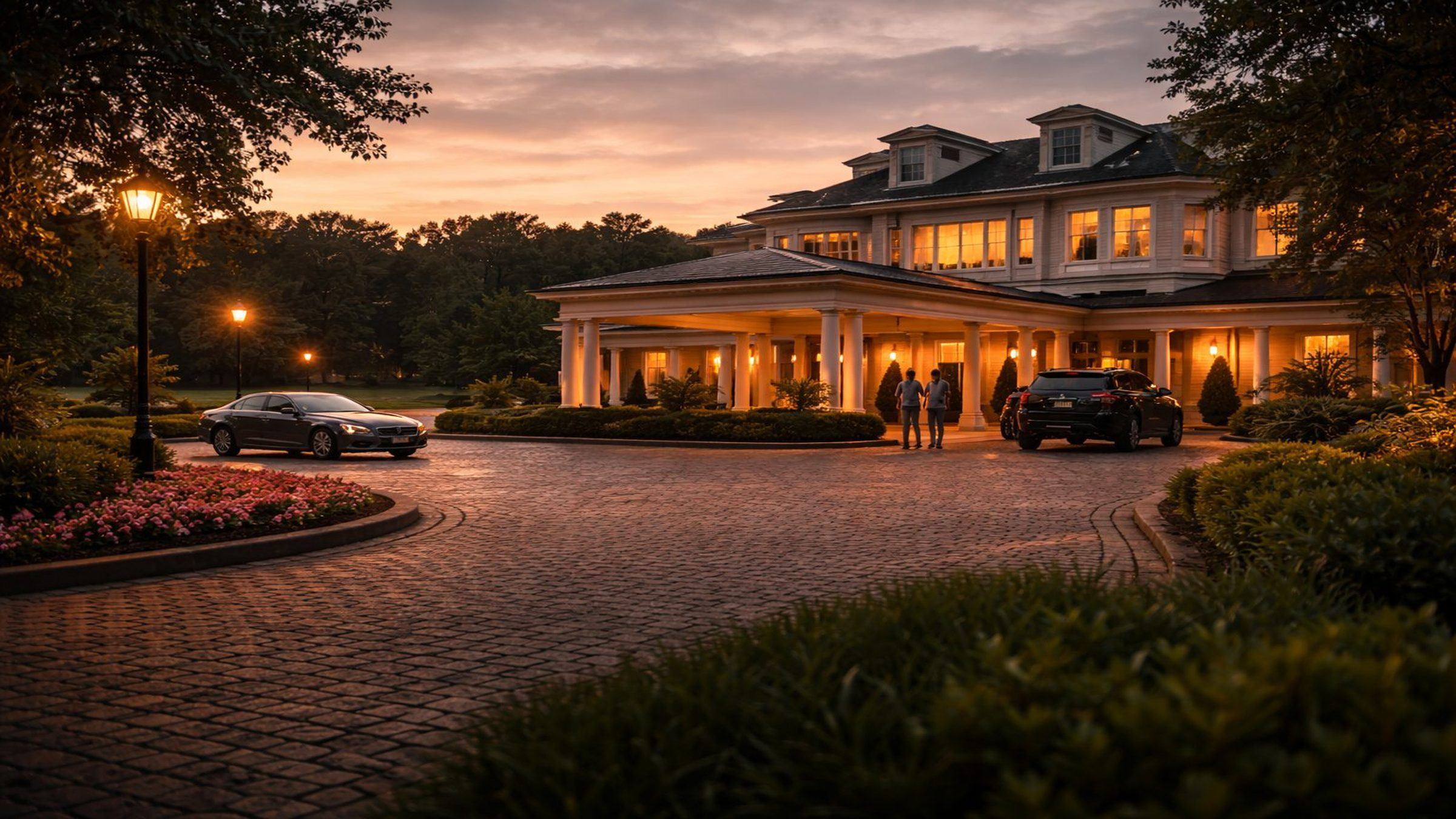
There is a moment that every member and every guest experiences every single time they visit a club. It begins the moment they turn off the public road and onto the club's property. It ends at the front door.
In most cases it takes less than two minutes. In those two minutes the emotional tone of the entire visit is set — before anyone has been greeted, before a club has been pulled from a bag, before a menu has been opened or a reservation confirmed. The impression formed in that window is not easily overridden by what comes after. A visit that begins well can absorb a minor service hiccup. A visit that begins poorly requires an extraordinary recovery effort to end on the right note.
This is the 200 yard zone. And most clubs are not managing it.
What the 200 Yard Zone Actually Is
The 200 yard zone is not a design concept. It is not a landscaping philosophy. It is an operational discipline — the recognition that the physical journey from the entrance of the property to the point of first human contact is communicating something to every person who makes it, and that what it communicates is either reinforcing the member's sense that this place is worth what they pay for it or quietly undermining it.
Every element of that journey is either managed or it is not. The condition of the entrance signage. The quality of the pavement or road surface. The landscaping along the approach — whether it is maintained with obvious care or allowed to communicate indifference through overgrowth, dead plantings, or seasonal neglect. The sight lines as the property reveals itself. The parking lot — its condition, its organization, whether it communicates order and attention or entropy. The bag drop — its staffing, the greeting that happens there, the efficiency of the interaction that begins the member's time on property.
None of these elements is individually decisive. But together they form an impression that arrives before conscious evaluation can begin.
"Members do not typically think to themselves: the signage looks tired, the road has a pothole. They simply feel, by the time they reach the door, either that they have arrived somewhere that takes itself seriously — or that they have not."
The Impression That Cannot Be Undone
The human brain forms environmental impressions faster than conscious thought can process them. By the time a member has parked and walked to the entrance, their emotional baseline for the visit has already been established. Excellent service inside the clubhouse can build on a strong arrival. It is significantly harder to reverse a weak one.
Clubs that invest heavily in interior renovations, F&B upgrades, and service training while allowing the approach and the bag drop to operate without deliberate attention frequently find that member satisfaction scores do not reflect the investment. The experience that was upgraded exists inside a frame that was not. And the frame is what members encounter first.
Staff and the 200 Yard Zone
The 200 yard zone is not only about the physical environment. It is also about the human environment — the first staff interactions that happen within it.
The bag drop attendant is often the first person a member speaks to on property. That interaction — its warmth, its efficiency, its personalization — sets a tone that carries through the entire visit. A member who is greeted by name, whose clubs are handled with care, and who moves through the bag drop feeling recognized and valued arrives at the first tee or the dining room with an emotional account that is already in credit.
A member who waits at the bag drop without acknowledgment, whose name is not known, whose interaction with the first staff member they encounter is transactional and impersonal, arrives everywhere else on property with a deficit that the rest of the team has to work to overcome.
The clubs that understand this invest in the bag drop with the same intentionality they bring to the dining room. They staff it with people who are genuinely warm, who know the membership, and who understand that their role is not logistical — it is relational.
What the 200 Yard Zone Reveals About the Club
The arrival experience does not maintain itself. It is the result of someone on the leadership team deciding it matters and inspecting it with the same rigor they bring to course conditions or dining room service. The clubs that get this right have assigned ownership of the zone to a specific person with a specific standard.
A club whose arrival experience has accumulated deferred attention is revealing something about its operational culture that goes beyond the physical details. If the standard allows for good enough in the 200 yards that every person experiences on every visit, it is reasonable to ask where else that same standard is being applied.
The 200 yard zone is a test. Every club is taking it every day. The score is visible to every person who drives onto the property.
The Investment That Pays Every Time
In most cases the investment required to bring the arrival sequence to a genuinely high standard is modest relative to other capital and operating expenditures. But it pays on every single visit. A prospective member being shown the property for the first time forms their impression of the club entirely within those 200 yards before they have met the GM or seen the course or sat down to lunch.
Members who arrive at a property that communicates care begin their visit in a different emotional register. They are more forgiving of minor imperfections elsewhere because the frame around the experience is already strong.
The 200 yard zone costs relatively little to get right. The cost of getting it wrong is paid on every visit, by every person who makes the drive.
Golf Vantage Advisors delivers executive-level financial and operational clarity to its clients across golf, resort, HOA, daily fee, and beyond — without the overhead of a full-time hire. If the questions in this piece sound familiar, we'd like to learn about your operation.